
There are times when the silence is the loudest sound. A ringing in your ears that isn’t really there, but it fills your head with every doubt, every fear, every echo of pain. For years, I chased that silence, hoping it would bring peace. Instead, it brought an emptiness, a hollowness that swallowed me whole. I tried everything to fill it – quiet contemplation, forced positivity, even just numbing out. Nothing worked. Until I found the noise. Not just any noise, but the beautiful, chaotic, visceral roar of grunge rock.
Why does noise help when quiet doesn’t? It’s a question I’ve been asked, and one I used to ask myself. I grew up in a household that valued calm, order. My instruments of emotional expression were often met with confusion, sometimes outright dismissal. When I first stumbled into the raw power of bands like Soundgarden, Alice in Chains, or Nirvana, it wasn’t just a discovery of music; it was a discovery of a language I didn’t know I spoke.

The first time a heavy, distorted riff from a band like Soundgarden hit me, it wasn’t an attack. It was an embrace. It was as if Chris Cornell’s voice, a force of nature, was screaming out the very anguish I felt, but couldn’t articulate. It felt like a release. A tangible, physical loosening of the knots in my chest. This wasn’t just background music; it was a soundtrack to my internal struggle, played by someone who understood.
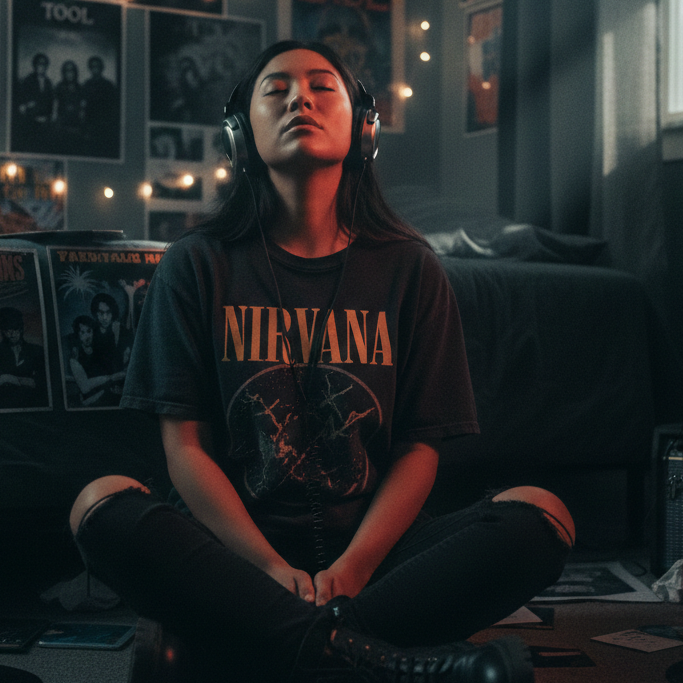
The beauty of grunge, for me, was its honesty. It didn’t pretend everything was okay. It wallowed in the messy, uncomfortable truths of life. The lyrics spoke of alienation, addiction, despair, and a profound sense of being lost—feelings often dismissed or hidden in polite society, but painfully real to so many. For a long time, I’d felt like an outsider, navigating a world that demanded a cheerful facade. Grunge gave me permission to feel what I felt, without judgment. It felt like a safe space, a communal mosh pit where all your raw emotions were not only accepted but celebrated. This was my emotional release through music.
There’s a concept called emotional congruence, where matching intense music to intense feelings can actually help you process them. It’s why listening to sad songs when you’re down can sometimes make you feel better, not worse. It validates your feelings. For me, the heavy basslines and distorted guitars weren’t just noise; they were a physical manifestation of my inner turmoil. The music became a proxy for my scream, a roar that I couldn’t unleash myself. It was a healthy, non-destructive outlet for emotions that otherwise felt suffocating.
I remember one particularly dark night, feeling utterly overwhelmed by anxiety. My chest was tight, my thoughts spiraling. I couldn’t focus on anything. I put on “Lithium” by Nirvana. The gentle, almost melancholic opening chords were a temporary reprieve, a moment of calm before the storm. Then, when Kurt Cobain’s voice erupted, raw and impassioned, it was like an internal explosion of everything I was holding back. The sheer force of it allowed my own trapped feelings to surface and, strangely, dissipate. It wasn’t a cure, but it was a powerful coping mechanism.
Nirvana for anxiety became an unexpected form of self-medication—a way to cleanse the emotional palate.


This isn’t to say that grunge music is a substitute for professional help.
Far from it. When the darkness gets too deep, reaching out to a therapist or counselor is paramount. But in those daily moments, those hours when the quiet feels oppressive and the world feels too much, grunge provided a lifeline. It taught me that it’s okay to not be okay, and that sometimes, the loudest music can bring the most profound peace.
It was my form of therapy through heavy music, a sonic balm for a wounded soul.
Pingback: The Catharsis of the Scream: Why Heavy Music Heal Us – The Gothknight